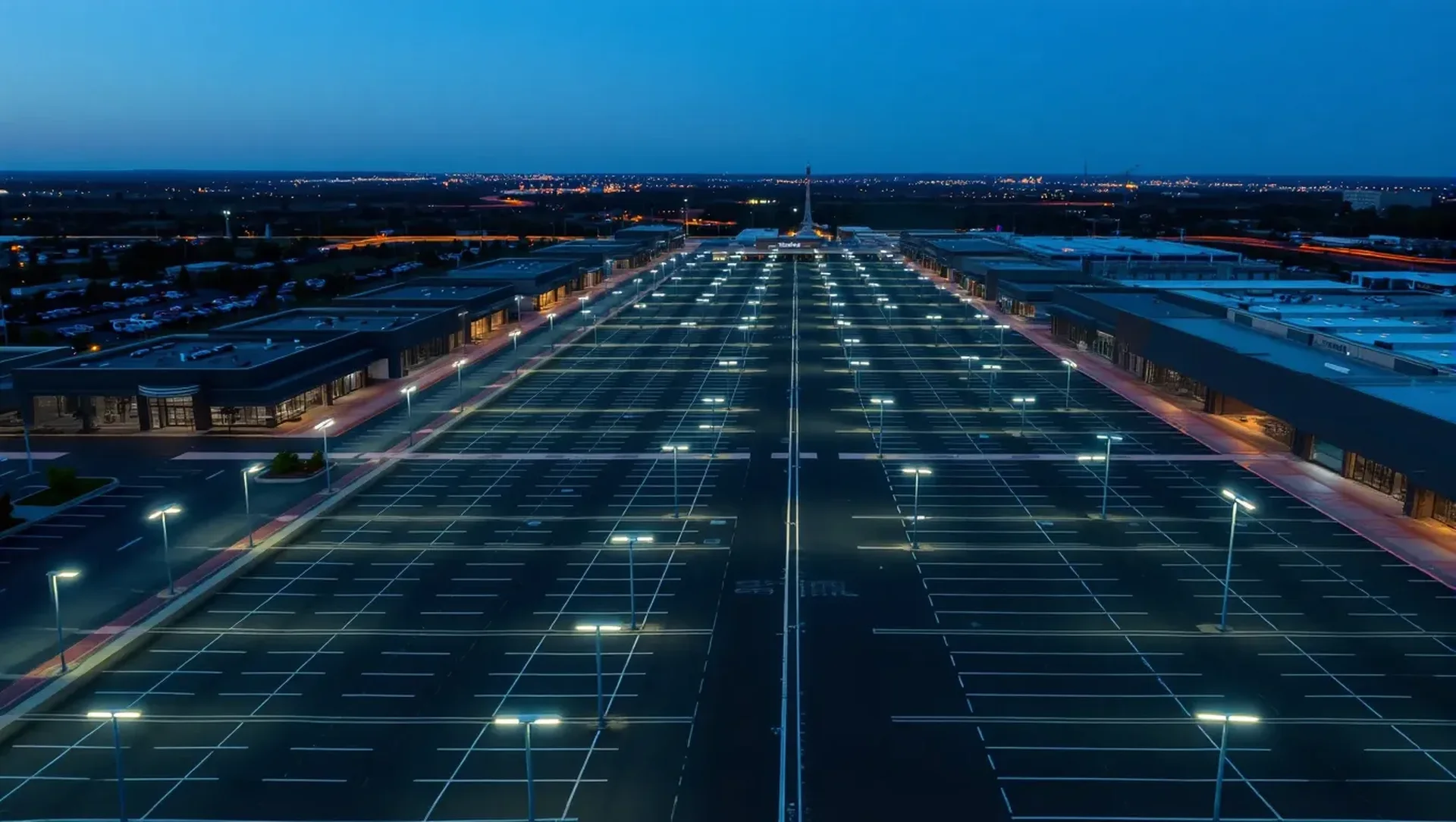
LED lighting
Commercial LED retrofits that pay for themselves.
Lighting is typically the single largest controllable operating expense in a commercial building. As your electrical contractor of record, we manage the full LED retrofit — audit, design, install, and post-install verification — under one licensed company, nationwide. Most commercial projects pay back in 1.5–3 years, often accelerated by utility rebates that cover 15–50% of project cost in active markets. We know because we measure.
The Problem
Old lighting costs more than you think.
A 400W metal halide fixture draws roughly 450W once you account for ballast losses. It degrades 30–40% in lumen output before anyone notices. It requires a bucket truck and a licensed electrician every time a lamp burns out — running approximately $17 per fixture per year in lamp, ballast, lift, and labor costs (based on portfolio project data). And it runs at full power whether the parking lot has 200 cars or zero.
LED eliminates all four problems — lower wattage, no ballast losses, no lumen depreciation curve, 50,000–100,000 hour rated life, and under $1 per fixture per year in maintenance (based on portfolio project data). The payback math is straightforward: most commercial LED retrofits recover project cost in 1.5–3 years. We know because we measure every project against actual utility bills after install.
Ranges from our own portfolio. Your proposal is built from your actual fixtures and utility bills.
How payback works
Savings start the night the lights switch on and accumulate every month. Once they cross the one-time project cost, every dollar after is yours — and we verify the crossing with measurements, not projections.
How it works
You know the savings and the timeline before any work begins.
Every project follows the same four steps, audit to verification, under one licensed contractor. No shortcuts and no surprises.
- Step 01
Audit
Every fixture documented — type, wattage, burn hours, light levels, condition. Photos and measurements for the full site, not a sample. This is the baseline everything else is built on.
- Step 02
Design
Photometric layouts engineered to IES standards. Product selection based on the application, not the manufacturer. Utility rebate pre-approval secured before any material ships.
- Step 03
Install
One licensed, accountable contractor. Phased schedules for occupied buildings — nights, weekends, or off-hours. All permits, code compliance, and inspections handled.
- Step 04
Verify
Post-install light level measurement confirms targets are met. Before-and-after energy data documents the actual savings. Nothing is estimated — it is measured.
What we retrofit
We retrofit every fixture type, in every kind of building.
Interior
Troffers, high bays, linear fixtures, emergency lighting. Offices, warehouses, retail, manufacturing floors. Typical energy reduction: 40–70% (DOE data). LED-to-LED upgrades included — first-generation fixtures from 2012–2016 are often 40–50% less efficient than current-generation equivalents.
Exterior
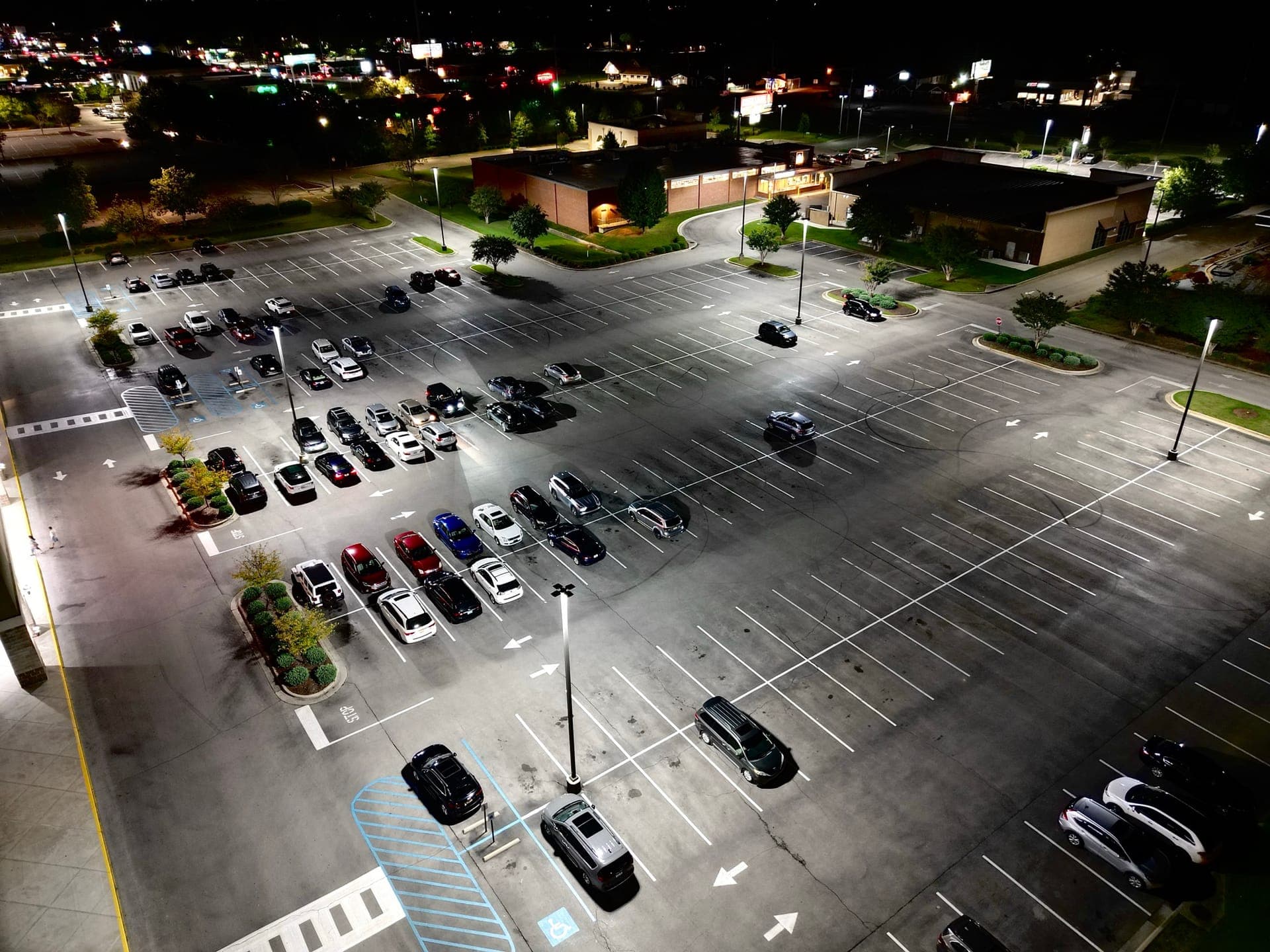
Parking lots, wall packs, canopy lights, pole-mounted area lights. The highest-value retrofit in commercial real estate — and where most of our work starts.
Sports
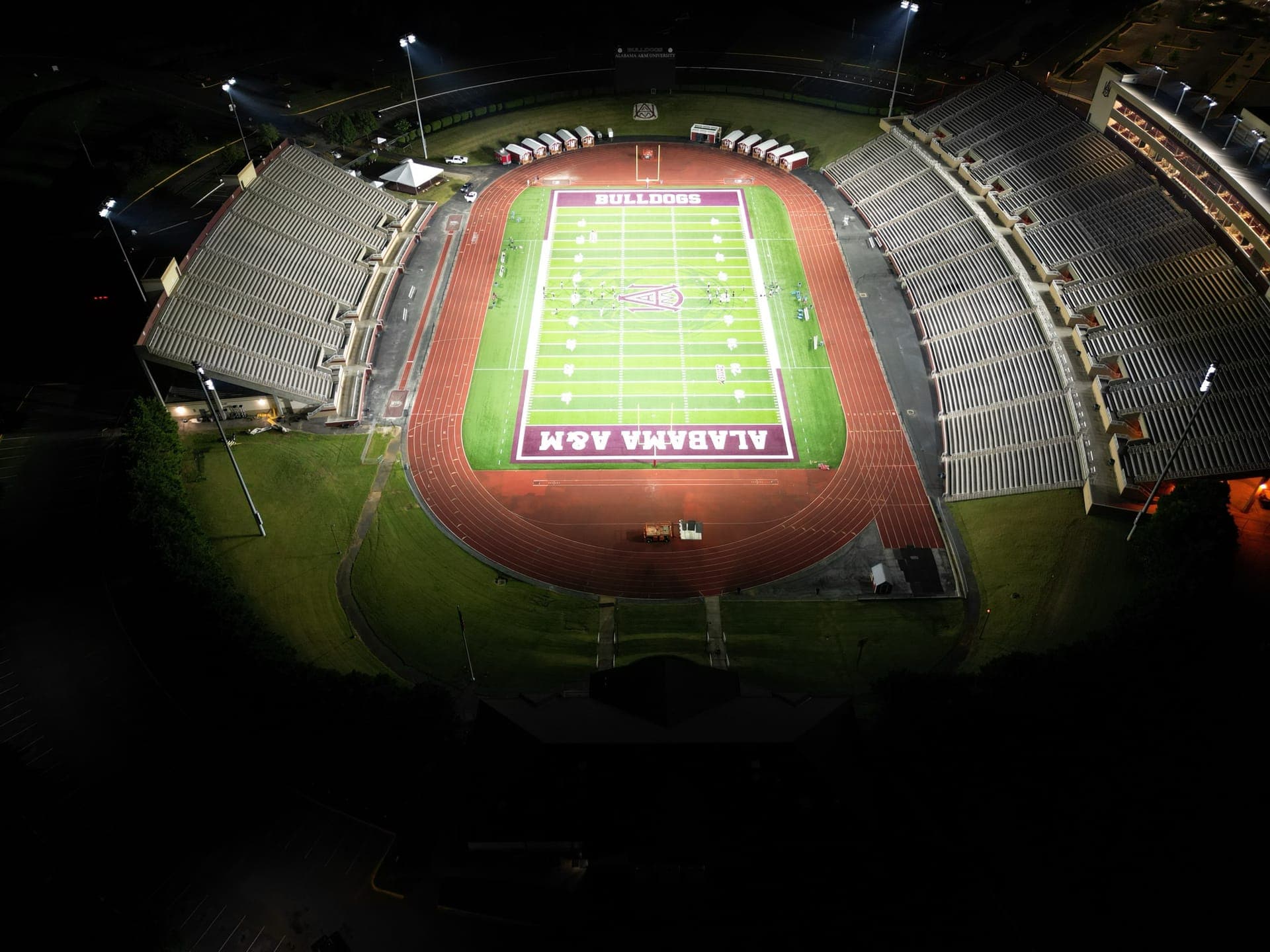
Stadium and athletic field lighting to IES RP-6-22 standards. 50-70% energy reduction with instant-on, flicker-free performance. No warm-up cycle.
Specialty
Parking decks, signage, landscape, decorative, and healthcare. Clinical environments require CRI ≥ 90 for accurate color assessment and flicker frequency above 1,250 Hz (IEEE 1789-2015 low-risk threshold). Surge protection, controls-ready wiring, and dark-sky compliance where required.
Why It Matters Who Does the Work
Licensed contractor. One company from start to finish.
Most lighting companies spec the fixtures, sell the project, and move on — and when something goes wrong later, nobody owns it. We are the electrical contractor of record: our license, our permits, our project managers, our warranty, our verification. When something needs attention, there is one phone call to make.
15+
Industries served
5
Offices nationwide
2015
Founded
Included in Every Project
Turnkey means turnkey.
You should not have to manage subcontractors, file rebate paperwork, or chase permit inspections. Every item below is included — not upsold, not optional.
- Full-site lighting audit with fixture-level photos
- Engineered photometric design to IES standards
- Utility rebate identification, application, and capture
- Licensed electrical installation, permits included
- All permits, inspections, and code compliance
- Post-install light level verification
- Before-and-after energy savings documentation
- In-house warranty management — one call to us, not the manufacturer
ESG & Scope 2
LED is usually the largest single Scope 2 reduction in the building.
A commercial LED retrofit typically eliminates 40–70% of lighting-related grid electricity — the biggest, cheapest, and fastest-payback lever in most Scope 2 inventories. The 2026 GRESB Real Estate Standard strengthened weighting on metered, verified energy data versus modeled estimates. Lighting’s kWh reduction feeds directly into GRESB’s Energy component — approximately 35% of the total score. Our post-install verification reports deliver fixture-level and circuit-level metered data: exactly what GRESB auditors require for the Performance Indicators sub-component. (Source: gresb.com, 2026)
See our full ESG & GRESB support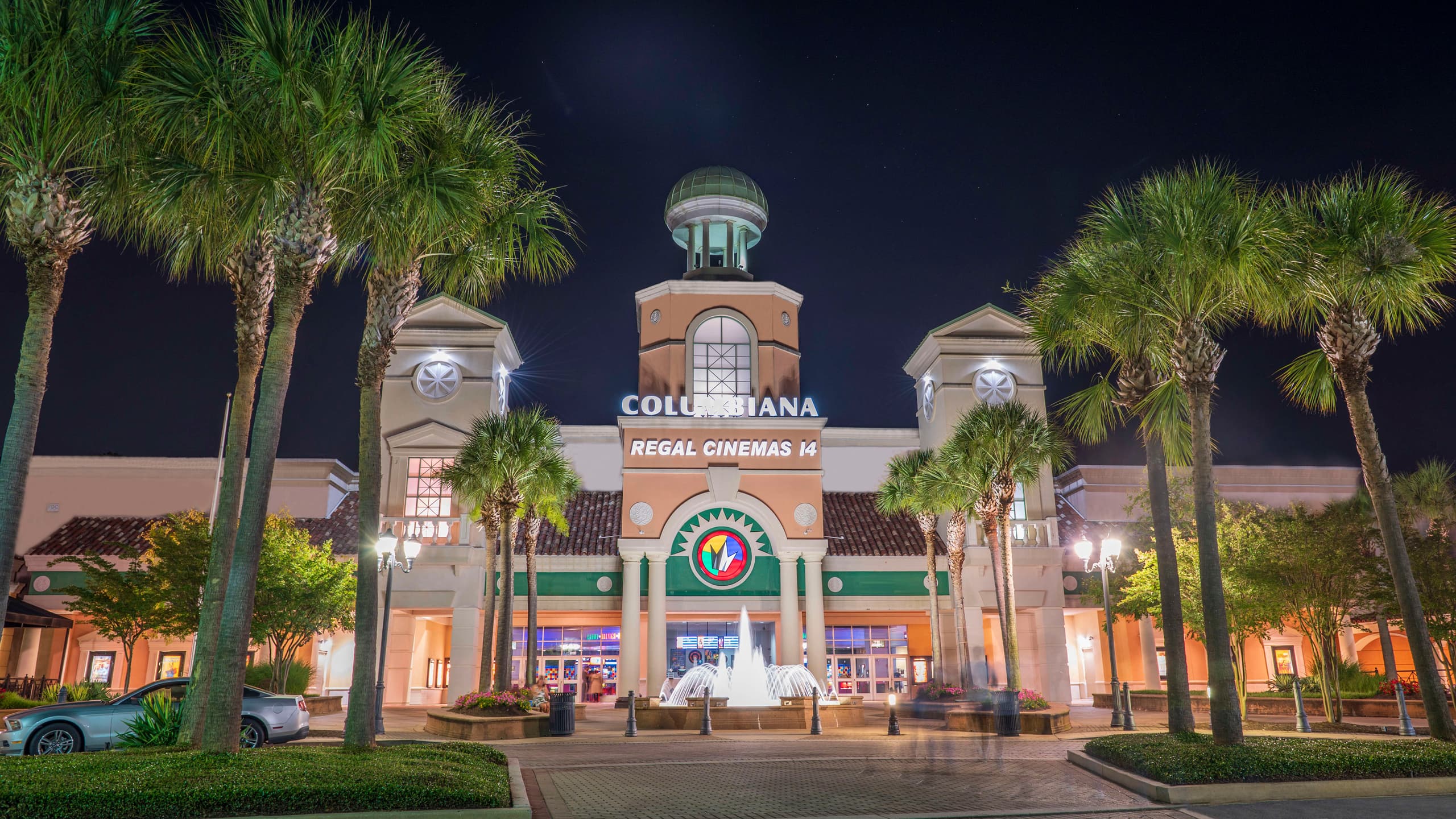
See the results
The owners we have already done this for.
Questions we hear from property managers.
How long does a typical LED retrofit take?
Most exterior retrofits take 1-2 weeks on site, with 2-4 weeks of lead time for fixtures and rebate pre-approval. Interior retrofits vary by scope but typically 1-3 weeks. We schedule around your operating hours — nights, weekends, or phased — so there is no disruption to your tenants or operations.
What is the realistic payback?
Most commercial projects land between 1.5 and 3 years. We know because we measure — every proposal is priced from your actual utility rate, burn hours, and fixture count, benchmarked against measured results from our own completed projects, and verified after install.
Do you handle utility rebates?
Yes. We identify, apply for, and capture every available rebate before the first fixture ships. Rebate pre-approval is built into the project timeline, not an afterthought. In many markets, rebates cover 15-50% of project cost.
What fixtures do you install?
We spec based on the application — not based on what a particular manufacturer is pushing. We prioritize DLC-qualified fixtures with 5+ year warranties and proven field reliability.
Will the project disrupt our operations?
No. Night installs for retail, weekend installs for offices, phased installs for 24/7 facilities. For manufacturing, we coordinate around shift changes. Most clients report zero operational disruption.
Do you pull permits and handle inspections?
Yes. We are a licensed electrical contractor working nationwide. We pull all required permits, coordinate with local AHJs, handle inspections, and provide as-built documentation.
Should I add controls at the same time as LED?
Yes. Adding controls later costs 2-3x more because you are paying to remobilize to the site. Even if you are not ready for networked controls, controls-ready wiring during the LED retrofit means you can add sensors and schedulers later without re-wiring. Controls typically add 20-30% in additional energy savings and can nearly double fixture life.
What if some of my building is already LED?
Many properties have partial LED — usually interior spaces or newer construction. We audit what is already in place and focus on the remaining inefficient fixtures. Most partial-LED properties still have 40-60% of available savings on the table.
My building has LED already — is a second-generation upgrade worth it?
Often yes. First-generation LED installed between 2012 and 2016 can be 40–50% less efficient than current-generation fixtures. A fixture operating at L70 (the standard end-of-life threshold, meaning 70% of original lumen output) is delivering noticeably dimmer light while drawing the same wattage as when it was installed. As of 2026, 22% more utility rebate programs explicitly allow LED-to-LED upgrades compared to prior cycles — a meaningful shift from programs that historically rewarded only HID-to-LED conversions. (Source: BriteSwitch 2026 Lighting Rebate Trends) We audit your existing installation against current fixture specs and run the payback math before recommending anything.
What are the LED specifications for healthcare facilities?
Healthcare is clinically distinct from commercial office or retail. Clinical spaces require CRI ≥ 90 so staff can accurately assess skin tone, tissue color, and wound conditions. Flicker frequency must exceed 1,250 Hz — the IEEE 1789-2015 low-risk threshold — to protect patients with photosensitive conditions. Patient rooms benefit from tunable white fixtures (2700K–6500K range) for circadian support. Procedure and exam areas have specific foot-candle minimums under ANSI/ASHRAE/ASHE 170. The good news: utility rebates still apply to all of this, and tax-exempt hospitals can access IRS §6417 elective pay — a direct cash payment equivalent to the 179D deduction — which almost no LED contractor currently handles. We audit your clinical environment against these standards and spec accordingly.
What if we don't have capital for the upfront project cost?
Lighting-as-a-Service (LaaS) is a financing structure where we fund the installation and you pay a monthly service fee drawn from the energy savings. There is no upfront capital outlay, NOI improvement begins on day one, and the monthly fee is treated as an operating expense — not a capital commitment. We can model both options side by side: outright purchase versus LaaS. Visit our financing page for detail, or ask us to include both scenarios in your proposal.
Are fixture prices going up? Should I lock pricing now?
Yes. The tariff stack on Chinese-manufactured LED fixtures currently runs 29–49% (base MFN rate plus Section 301 and IEEPA layers). Major fixture brands passed 10–25% of that cost increase to buyers beginning in mid-2025. Supply chains are nearshoring to Vietnam and Mexico, but that transition has not returned prices to pre-tariff levels and has extended lead times on some SKUs. (Source: Lighting Daily, LogiqSupply, ProLighting; 2026-08-16) Locking scope and pricing with a signed proposal protects you from the next price adjustment cycle. Waiting does not.